






.webp?width=1080&height=1080&name=benefits%20(1).webp)












.webp?width=300&height=300&name=Auto%20Dealerships%20(1).webp)






.webp?width=130&height=130&name=accountant%20icon%20(1).webp)


.webp?width=300&height=300&name=Website%20Image%20(8).webp)
.png?width=1080&height=1080&name=support%20(2).png)









Are Expense Reimbursements Taxable?
Expense reimbursements are not taxable if they are paid under an IRS accountable plan, meaning the expense had a business purpose, the employee substantiated it with documentation, and any excess advance was returned. If a reimbursement fails any of those three tests, it becomes taxable wages subject to income tax withholding, FICA, FUTA, and SUTA.
The distinction matters more than most employers realize, because a flat monthly allowance paid without receipts is taxable even when every dollar of it was genuinely spent on the business. Here is what separates the two.
Key Takeaways from this Article
- Accountable plan reimbursements are tax free. Non-accountable plan reimbursements are taxable wages.
- Three tests decide it: business connection, substantiation, and return of any excess advance.
- Documentation is what makes the difference, not the nature of the expense. The same mileage payment can be tax free or taxable depending on whether a log exists.
- The FLSA requires reimbursement when an unreimbursed expense would drop a non-exempt employee below minimum wage, which bites harder in Maine because the state wage is well above federal.
- A written expense policy is the cheapest compliance control you can put in place.
What is an Expense Reimbursement?
An expense reimbursement is a payment an employer makes to an employee to cover out-of-pocket costs they incurred doing their job. It is a repayment, not compensation, which is why it can be tax free when handled correctly.
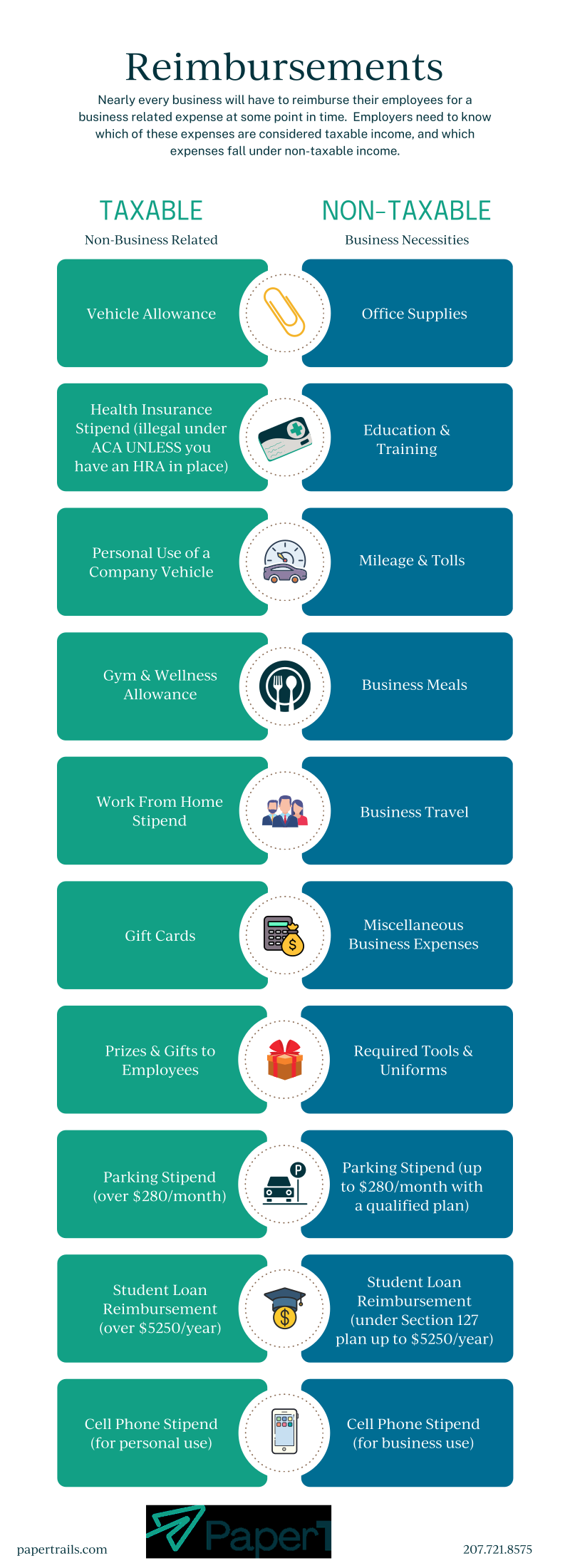
Common examples include office supplies, business travel and lodging, work-related meals, business use of a personal vehicle, tools and uniforms, education and training, and wellness stipends.

Are Expense Reimbursements Taxable?
It depends entirely on whether your reimbursement arrangement qualifies as an accountable plan under IRS rules. There is no middle ground: a plan is either accountable, in which case reimbursements are excluded from wages, or it is not, in which case every payment under it is taxable.
| Accountable plan | Non-accountable plan | |
|---|---|---|
| Taxable to employee | No | Yes |
| Income tax withheld | No | Yes |
| Subject to FICA, FUTA, SUTA | No | Yes |
| Reported on W-2 | No | Yes, as wages |
| Receipts required | Yes | No |
| Excess advance returned | Required | Not required |
Accountable Plan Requirements
Three conditions, all of which must be met:
- Business connection. The expense was incurred performing services for the employer.
- Substantiation. The employee documents the expense with receipts, mileage logs, or equivalent records, generally within 60 days.
- Return of excess. Any advance beyond actual substantiated expenses goes back to the employer, generally within 120 days.
Reimbursements that typically qualify include office supplies, education and training, mileage and tolls up to the IRS standard mileage rate, business meals within IRS guidelines, travel including lodging and airfare, required tools and uniforms, educational assistance under a Section 127 plan, qualified parking up to the annual IRS limit, and business-use cell phone stipends.
Each of those carries its own conditions. A cell phone stipend is tax free only when the phone is genuinely required for business, and mileage above the standard rate is taxable on the excess.
What Makes a Reimbursement Taxable?
Failing any one of the three tests moves the payment into wages. In practice, the failure is almost always substantiation.
Payments that are commonly taxable include a flat vehicle allowance paid without mileage logs, personal use of a company car, a gym or wellness allowance for personal use, an undocumented home office stipend, and gift cards, which are taxable at any amount with no de minimis exception.
A health insurance stipend paid as cash without a compliant arrangement such as an HRA deserves separate mention, since that is not merely taxable but can violate the Affordable Care Act.
Does an Employer Have to Reimburse Expenses?
The Fair Labor Standards Act does not require reimbursement for every business expense. It does require it when the expense is necessary for the employee to do the job, and paying it out of pocket would push a non-exempt employee's earnings below minimum wage for that workweek.
This matters more in Maine than in most states, because Maine's minimum wage sits well above the federal floor. The higher your state wage, the smaller the cushion between an employee's pay and the legal minimum, and the sooner an unreimbursed expense creates a violation.
Some expenses are typically excluded from reimbursement altogether: personal clothing and grooming unless the job requires it, commuting between home and work, personal meals, and relocation costs unless agreed in advance.
What Should an Expense Policy Include?
Even a two-person business benefits from writing this down. A policy in your handbook should define which expenses are reimbursable, what documentation is required, how to submit a request, and the timeline for submission and payment.
Beyond the policy itself, four habits keep you out of trouble. Require substantiation every time rather than for large amounts only, since the IRS rule has no dollar threshold. Automate the tracking, because expense management software enforces documentation that a paper process quietly skips. Keep records for audits. And review the policy annually, since IRS limits and state rules both move.
FAQs: Expense Reimbursements
-
Not if they are paid under an IRS accountable plan. That requires a genuine business purpose, documentation from the employee, and the return of any unused advance. If the arrangement fails any of those three tests, the reimbursement is taxable wages and subject to income tax withholding, FICA, FUTA, and SUTA.
-
No, provided they meet accountable plan rules and are properly documented with receipts or per diem records. Travel is one of the most straightforward categories to reimburse tax free, because the business purpose is usually obvious and the receipts already exist.
-
Only if it is tied to documented business use. A flat monthly amount paid to everyone working from home, with no substantiation, is taxable wages. A reimbursement for a specific documented business expense is not. The deciding factor is documentation rather than the amount.
-
Yes. A flat allowance paid without mileage logs fails the substantiation test and is treated as taxable wages, even if the employee genuinely drove for business. Reimbursing actual documented mileage at or below the IRS standard rate keeps it tax free instead.
-
Generally no. The Tax Cuts and Jobs Act suspended the miscellaneous itemized deduction for unreimbursed employee expenses for most workers. Limited exceptions remain for certain categories including Armed Forces reservists, qualified performing artists, and fee-basis government officials. IRS Publication 529 has the current detail.
How Can Paper Trails Help?
Most reimbursement problems are not disagreements about what counts as a business expense. They are documentation gaps found later, usually when a flat allowance someone set up years ago turns out to have been taxable wages the whole time.
At Paper Trails, we help clients build accountable plans that hold up, set reimbursements to the right taxability in payroll, and automate the substantiation so it happens by default rather than by memory. Our team is in Kennebunk, and our pricing is published on our pricing page.
Updated: September 2026
Written by: Jon Portanova

Want help putting this into practice?
Talk with real people here in Maine who work with small businesses like yours every day.